


Sue and Don offer a two-bedroom guesthouse B&B across the way from the farmhouse where they live. Don’s parents, both artists, built the guesthouse and designed the gardens in the 1970s. The guesthouse is lovely and very comfortable, with a large, open sitting room that features lots of wood and big windows that lead onto the deck and panoramic view down the hill to the east. Cozy chairs and couches offer families the chance to settle in for one of the games or puzzles they can choose out of the closet. There is also a dollhouse that’s great for kids. Lots of neat antiques hang on the walls -- a wooden shovel, a huge pan, and other tools for farming and cooking that have been in Don’s family for generations.
The Master Suite offers a king bed (or two twins), a full bath, and direct access to the large deck. The attached sitting room has a futon that can sleep two more guests when needed. On the lower level, the Cedar Room has a queen bed and a full bath with a tile shower. A rollaway bed is available for additional guests. Children are welcome.


Some guests, says Don, like to stay on the farm and help out, while others spend their days visiting nearby Lake George, Saratoga Springs, or Vermont. Within Washington County, there are covered bridges, and annual cheese, maple, and fiber tours. The Battenkill River also offers premier fly fishing. For those who prefer to stay on the farm, guests might have the opportunity to harvest fruits and vegetables, help with maple sugaring, or feed the animals, depending on the season. Croquet and horseshoes are options in the summer, and in the winter guests can ski and snowshoe right out the door of the guesthouse. At night, says Don, with no light pollution, it’s ideal for stargazing.
For breakfast, Don prides himself in using the best ingredients from Lant Hill and his neighbors’ farms. You might be treated to fresh berries, pancakes with Lant Hill maple syrup, smoked meats, yogurt from the Argyle Cheese Farmer down the road, and milk and cream from the Battenkill Valley Creamery. Says Don, “We’re pretty close to being on a 100-acre diet here. The main things we need to import are salt and vitamin D ... We like to support our neighbors. A lot of the county’s dairies are gone. The ones that are left are looking for a niche, like making cheese or bottling their own milk.” Some of Don’s breakfast treats are old Swiss recipes -- like yogurt with fresh fruit and grains -- that were passed down to him by his mother.

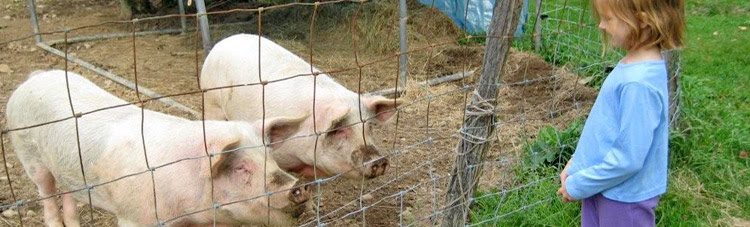
Farm History
Don bought Lant Hill Farm in 1971, after moving to the area to work as a farrier, a specialist in horse foot care and shoeing. Don had been working with horses since he was nine years old. When looking for a farm, Don wanted to find a place with a big spring, woods, and fields. He was also looking for land that was relatively free of chemicals, and since the Lant family had farmed the land for generations, using crop rotations and minimal chemical sprays, Lant Hill Farm seemed like the right place for him to settle down.
Don says he’s always farmed the same way, without synthetic chemicals. He also uses principles from biodynamic agriculture (a form of organic farming) and permaculture. Don’s aim is to find a natural balance between pests and their predators so that there’s no need to treat the vegetables and fruits.
When I ask Don what led him to farming, he recalls the first time he ate in his school cafeteria, in first grade. During his childhood in Southern Connecticut, Don was used to eating his mother’s fresh, biodynamically grown food (she had studied biodynamics in Switzerland). “The cafeteria food was so bad,” says Don, “that it made me sick.” Don realized then the importance of good fresh food to him. Further explaining his attraction to farming, says Don, “you are drawn to certain areas where you feel good. I wanted food I could trust. I didn’t want to work for a company.”
For 30 years, Don drove a school bus in Argyle in addition to farming and working as a farrier. He would get up, check on the animals, drive the bus for two hours, shoe horses, drive the bus for three more hours, then go back to the farm and feed the animals. Small towns would often draw their bus drivers from the farming community, as the farmers were the ones who could easily figure out how to work the buses. The dependable income from bus driving and the hours complemented farming well.
Beef
Don currently has 10 beef cattle, which he raises and finishes on grass. Most customers come to the farm to buy meat, and Don does some deliveries as well. One of his goals with the cattle has been to develop his own genetics to produce animals that are strong, healthy, and well-suited for his land. Don also aims to create a special flavor in his beef, which graze on Lant Hill's unique mix of grass, herbs, and other plants.
Maple Sugaring
Maple Sugaring
When tapping trees, Don is careful to treat them well. He makes his taps 2-4 inches away from the scar of the old holes. The first step is to drill into where the sapwood sits. He has close to 200 taps on 150 trees -- most trees have two taps. Don uses plastic tubing and gravity to draw the sap downhill to his wood-fired evaporator. To boil down the sap, he says, you bring it to 7 degrees above the boiling point. It’s time to start boiling when you have 300-400 gallons of sap, which sounds like a lot, but it doesn’t take long to collect that much from his 200 taps.
 Don is finishing work on his sugarhouse, which he recycled from a building that had been torn down. He’s still planning to add a room for canning, finishing work, and for socializing. Don admits to being something of a hermit. “But,” he says, paraphrasing the old Adirondack hermit Noah John, “what’s the sense of being a hermit if you can’t meet anyone?”
If you go:
The Master Suite (king bed) starts at $125/night, for bed and breakfast, and the Cedar Room (queen bed) starts at $95/night. Children are welcome.
www.lanthill.com
(518) 638-8003 / lanthill@localnet.com
Hosts: Don Previtali & Sue Kowaleski
RD 1, Lant Hill Farm
687 McEachron Argyle, NY 12809 Hill
Photos 1 and 4 courtesy Lant Hill Farm.
Hosts: Don Previtali & Sue Kowaleski
RD 1, Lant Hill Farm
687 McEachron Argyle, NY 12809 Hill
Photos 1 and 4 courtesy Lant Hill Farm.


 Posts
Posts


.jpg)