Showing posts with label pa farm vacation association. Show all posts

Monday, November 22, 2010

Berry Fields Farm: Our Family Farm Vacation

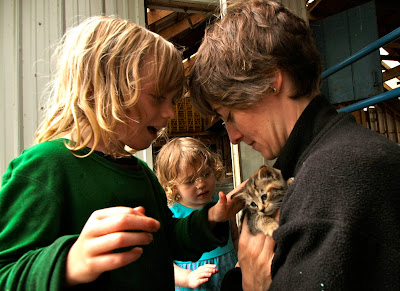
I had visited lots of farm stays on my own, so I wanted to see how my parents, sister, and her two cutie pie kids liked the experience. Last August, I planned a farm vacation to Berry Fields Farm in North Central PA for the five of us. I especially wanted to see how my nieces Skylar (5) and Ruby (2) took to gathering eggs and feeding the animals, and to snap a few adorable pictures of them along the way.

My parents live in Western PA, my sister and her kids live in Connecticut, and I live in Maryland; Berry Fields Farm was almost equidistant for the three of us. In addition to the location, I loved that the farm had a tiny field-to-table restaurant, a farm store, and a focus on growing diverse crops and livestock sustainably. Plus, my family and I are blueberry fiends and figured the berry bushes at the farm would be heavy with fruit, and we could pick gallons of them to take home and freeze. The drive to Berry Fields winds through Pennsylvania's beautiful Endless Mountains region, with the last two miles climbing a gravel road up the side of K-hill Mountain. I arrived to the hill farm just after dusk, and my sister pulled in with the kiddos a few minutes later. My parents would arrive a few hours after us.


After stepping out of my car, the warm lights of the restaurant and farm store guided me inside, where I met Barbara Gerlach, who was finishing serving coffee to her dinner guests. She pointed me towards the stairs to my family's home for the next three days, a one-bedroom apartment that the Gerlachs renovated for guests just this year. It's the second apartment they have built on their farm. Our cozy place was just big enough for our group of 3 adults and 2 kids. My parents took the bedroom, I slept on the futon in the small entrance room, and my sister and nieces slept on the pullout couch in the living/dining room/kitchen. The farm's other apartment, which the Gerlachs opened to guests about ten years ago, sleeps up to 10 in three bedrooms and sits on the second floor above the farm store and restaurant. 

In the 1970s, Charlie Gerlach bought the property where Berry Fields Farm now stands. The land was much different then -- it was covered with forest and only had a primitive hunting cabin. Charlie and Barbara spent decades clearing the land, and building their house and barn using recycled materials from Charlie's design-build general contracting business. Charlie describes his desire to build things as almost a compulsion. He plans to add at least one more guest apartment to the two others already on the farm. Charlie and Barbara have slowly built up their poor mountain soil to grow their lush, 1-acre organic garden, and have planted a small orchard of apple and pear trees as well as putting up fencing for their grazing beef cattle. Down the farm's driveway and across the road, a field of blueberry bushes invites u-pickers. Weekly, Barbara and Charlie sell meat and produce at a farmers market in Eagles Mere, a nearby resort town.


Day 1
In the morning, we woke to a big, wonderful view out the living room window. Skylar was jumping to get outside and see what animals she might find, and Ruby was excited to be a part of it all too. Once we met the bunnies, it was hard to pull the kids away. Skylar and Ruby could have fed them for hours, poking grass and weeds through the wire cages and watching while they chewed. Barbara and Charlie also introduced us to the chickens and showed us how to collect eggs, pointed out their huge pregnant Tamworth pig, and found a hidden pile of kittens for us to cuddle. We all had a great time wandering around the farm. We decided to venture away to visit the nearby World's End State Park, where a s-shaped bend in Loyalsock Creek that forms a big, scenic swimming hole. After a dip in the chilly water, we headed back to the farm for a field-to-table dinner in the little restaurant. We had a lovely meal of greens, beef, mashed potatoes, and corn, all raised on the farm, with locally-made goats milk cheesecake and hot drinks for dessert. 


Day 2
The kids headed out again for their dose of animal feeding and petting. Charlie and Barbara told us that the blueberry season had ended early, and that the bushes were pretty much bare, but we were unshakable and went to forage for leftovers anyhow. We managed to wrangle a few berries, enough for a little taste. We asked Barbara for hiking recommendations, and she pointed us towards The Haystacks, where a gentle, relatively flat trail along the Loyalsock River and rounded rock formations make for picturesque pools and rapids. The trail was a great choice for hiking with kids. 

Day 3
For our last day at the farm, we stayed put and found plenty to do. We harvested a bed of onions, with Skylar taking the helm and pulling almost all of them by herself. Charlie rewarded us with a loaf of bread that he had made that morning. We pulled spent cornstalks and threw them to the cows. We helped Barbara search for ripe carrots in the greenhouse. We watched the beautiful changing sky as a storm blew through. And to end the day, cozy again in our apartment, we cooked up a feast in our little kitchen.

It was a great vacation.  We loaded up our coolers with beef, pork, and chicken from the farm since the quality was great and the prices were much better than what we could find at home, bid the farm goodbye, and went our separate ways. For more photos from our stay at Berry Fields, check out my Berry Fields Farm album.

If you go:
Berry Fields Farm has two guest apartments. One can sleep 10 in three bedrooms; the other can sleep a very cozy 7 in one bedroom, a futon, and a twin and double pullout beds. Both apartments have full kitchens. Rates start at $100/night and $600/week. Meals are available ($15-30) on the farm with advanced notice; non-guests are welcome to reserve dinners in The Strawberry dining room as well. The farm’s beef, pork, chicken, sausage, vegetables, and fruits are available at the farm store. Berry Fields also offers u-pick berries in season.

Note: some of the material on the website is outdated, for example, the farm now has two guest apartments instead of one. Also, it’s a great idea to ask what fruits and vegetables are in season before you go, so you know what to expect and don’t suffer from blueberry disappointment.

Web: 
http://www.berryfieldsfarm.net 
gerlach@epix.net


Postal/Physical Address:
 
Charlie and Barbara Gerlach
Berry Fields Farm

New Albany, PA 18833
Telephone:
 570-924-3019

Wednesday, July 28, 2010

Brightwood Vineyard and Farm

Sitting on the wraparound deck of the Brightwood Farm cottage makes you feel like you’re up in the trees. The Robinson River winds through in the valley below, and the loudest sound you hear is the cicadas’ buzz. Inside of the cottage, large windows still let you enjoy the view and the vibrant green of the summer canopy. The cottage is a very cleverly planned 600 square feet, with every nook and cranny serving some purpose. Susan and Dean Vidal designed their guest cottage around an A-frame that the farm’s previous owners built in 1974. One of the Vidals’ ideas for the farm, from the time they moved there 10 years ago, was to share the beautiful farm they had found. 

Because of their relationship with the previous owners, the Vidals didn’t want to tear down the A-frame, so they added on a kitchen and eating nook, a bedroom, two sleeping lofts, and the wraparound deck. Dean and Susan’s daughter, who is now a full-time green carpenter in Colorado, worked on the cottage addition and restoration with her boyfriend. They reclaimed American chestnut and maple from a barn to build the hardwood floors, and added green features like double-glazed windows, energy-efficient walls, and a clean-burning Jotul wood stove.

When I visit Brightwood Farm, a London couple is staying at the cottage. They tell me, “This is paradise for us. Right now our flat in London is so noisy, there’s always construction and drilling going on. Nobody can afford to move right now, so everyone is doing construction work.” They say their son, Oscar, at 17, “is usually on Facebook at home, but he loves it here.” When Susan and I walk up to the cottage, Oscar is running back from feeding the goats. He looks really happy. Susan tells me, “It’s not just the kids who love feeding the animals. The adults love it too. And collecting eggs!” Susan invites guests to help as much or as little as they like.

For breakfast, Susan gives guests a choice of a cook-your-own meal where she provides the ingredients, or a prepared continental breakfast. The ingredients, Susan says, are “really local things” -- Brightwood Farm’s own eggs and fresh berries in season, sausage and breakfast meats from the Vidals’ neighbors, muffin or pancake mix, and farm-made jam.

The farm

As Susan Vidal tells it, she and her husband Dean used to be “regular suburban people.” But after their children left home and they became inspired by a trip to French wine country, the Vidals agreed they didn’t want to stay around the congested DC Beltway forever (they used to live in Arlington, VA). The Vidals decided to buy a farm where they could grow wine grapes. A search around Virginia’s best wine-growing counties led Dean and Susan to Brightwood Farm in scenic Central Virginia, just east of the Blue Ridge Mountains. The farm sits on 100 hilly acres, with 35 acres of pasture where the previous owners raised beef cattle. Susan tells me: “Before, I worked as a cartographer. It was a great job. But farming is a much better fit for me than working in a cubicle. I always had trouble with that.” Dean, an engineer, still commutes to his job. 

The Vidals also enjoy the help of a few interns who come to them through ATTRA (National Sustainable Agriculture Information Service) and WWOOF (World Wide Opportunities on Organic Farms). The interns live on the farm -- either in a three-year-old insulated, four-season yurt with a woodstove, or on a tent platform.

Although the Vidals originally set out to make Brightwood Farm into a winery, they quickly realized that they wanted to do much more than just grow wine grapes. From the beginning, the Vidals have grown their farm through diversification -- their primary enterprises are now laying hens and berries. They also raise goats, sheep, vegetables, ducks, and donkeys. When I ask Susan how they learned to farm, she says, “We just kind of launched ourselves into it. We started everything small, and learned by doing.”

In the Vidals’ first few years of farming, they grew an acre of pumpkins following Virginia Cooperative Extension’s recommendations for pumpkin cultivation. Brightwood Farm was not organic then, and Extension’s guidelines involved regular spraying of synthetic fungicides and pesticides. As Susan explains, “The sprays kept the pumpkin leaves nice and green, but the fungicides dripped down into the soil and killed the soil microorganisms. Our yields decreased each year as soil fertility declined. You can kind of prop up the production if you keep adding more fertilizers, but we didn’t want to do that.” The Vidals transitioned Brightwood Farm to a certified organic farm in 2007.

True to their diversification strategy, the Vidals currently grow five kinds of raspberry and four varieties of blackberry. The Vidals grow diverse plant varieties to improve their chances of getting good yields despite attacks from insect and disease -- certain varieties might be more resistant to one pest, while another variety is resistant to a different pest. The Vidals also look for plant varieties that thrive without chemical inputs. In addition to the berries, the Vidals raise a diverse collection of vegetables. They grow some vegetables at Brightwood Farm, where they have a shade house that holds salad greens much of the year, and a hoop house for growing warm weather crops. They grow the bulk of their vegetables (which mostly go to restaurants) on 10 acres of a neighboring property. 

Brightwood Farm is also a small winery, just as the Vidals originally planned, but the wines they make are different than what you might expect. Susan tell me, “We’re still working on the grape part. It’s a challenge doing grapes organically. In the meantime we started making blackberry, elderberry, and elder flower wine ... We do dry wines, so they’re not the run-of-the-mill fruit wines, either.” After Susan offers me samples of their wines, I can vouch that Brightwood Farm’s fruit wines are not only unusual, they’re also really delicious.

Dean Vidal makes all of the wine for the farm in 15-gallon batches in the state-certified commercial kitchen in the basement of their house. In the kitchen, the Vidals and their workers also make jam and process dried herbs for tea. 

With their livestock, the Vidals choose specific breeds for their vitality and versatility -- heritage chickens for eggs and meat, easy-keeping Spanish meat goats, and they’ve recently started raising dual-purpose Tunis sheep. They look for animals that do well on average pasture, without needing much supplementary grain.

Brightwood Farm’s 120 laying hens live in a movable house that allows Susan to easily shift the hens to fresh pasture as soon as they’ve clipped short the grass in their current spot. Susan says, “We generally go for the older, dual-purpose breeds, because after they stop laying they become stew hens.” The Brightwood chickens’ breeds have wonderful old names like Speckled Sussex and Buff Orpington, some of which are rare breeds that farmers like Susan are trying to bring back from endangered status. Susan also enjoys raising her own chicks. She tells me, “We have to buy in purebreds some years because we have no way of selecting the best layers. But this year, I’m looking for broody hens that want to sit -- I’m looking for volunteers!”

The Vidals’ Spanish meat goats also have a remarkable lineage. Spanish meat goats, now rare, are descendants of the goats brought to America by early settlers, mainly the conquistadors and missionaries of the Southwest. These Spanish goats were abandoned or escaped their farms, and lived in the wild for many generations before being re-domesticated. As a result, they are easy keepers, and great moms - they have very little trouble kidding and nursing. Spanish goats’ mixed heritage also means the goats come in different colors. As Susan says, “It’s fun when they’re born ‘cause you never know what color they’re going to be.” The goats have a furry, friendly guardian dog, named Athena, to protect them from predators like coyotes. Each group of animals on the farm enjoys the protection their own guardian dog. Susan says fondly, “We couldn’t do it without the dogs!”

The Vidals originally brought donkeys to the farm to protect the livestock from predators. “But,” says Susan, “They were hard on the little goats.” The Vidals now rely on the three donkeys for fertility. “Since we’re organic,” says Susan, “We rely on non-commercial fertilizers. And, the donkeys like the guests and the guests like the donkeys.”

 The Vidals sell their produce, wine, meat, and eggs at two very different farmers’ markets, Charlottesville (where there are around 100 vendors and Brightwood Farm sells wine, jam, and meat), and the more local Madison farmers’ markets (where there are only 8-10 vendors, and the customers mostly ask for vegetables.) The Vidals also sell to restaurants through a Virginia-based company called The Fresh Link, whose tagline is “Family Farms to City Plates.” Twice a week, the Vidals post information about what produce they’re offering to The Fresh Link, where the information is made available to restaurant chefs, who order the exact kind and number of heirloom tomatoes and free-range eggs they need.

If you go:

The Brightwood cottage sleeps up to four on one queen bed and two twin loft beds. Rates are $110/night weekdays and $155/night on weekends, double occupancy. Additional guests are $20/person, per night. The farm is two hours from Washington DC and 45 minutes from Shenandoah National Park. Farm activities (for guests who are interested) include feeding goats, sheep, and donkeys and collecting eggs. Guests are also welcome to swim in the Robinson River and walk on trails that wind through the farm’s “back 40.”

(540) 948-6845
svidal@hughes.net
www.brightwoodvineyardandfarm.com

Dean and Susan Vidal
1202 Lillard's Ford Rd.
Brightwood, VA 22715

Monday, June 14, 2010

Canter Berry Tails Apple Ranch

Canter Berry Tails Apple Ranch is an 1820s, four-bedroom vacation home rental on a 51-acre apple and vegetable farm near Gettysburg, PA. The house is decorated with incredible care and detail, and owners Ted and Sandy take great pride in all they’ve done to restore the house. Each of the bedrooms has a theme: there is the garden room, the hunting and fishing room, the North room, and the South room. “Each mattress,” says Ted, “will fit different people. Some are firmer; some are softer … and with the decorating, we try to give everybody something they can relate to.”

Much of the house is furnished with auction purchases and yard sale finds: there’s a kitchen wall covered with cast iron trivets, a glass-door cabinet full of whimsical antique food containers, and an antique desk that holds old postcards that guests can use for sending notes to friends. Sandy intricately hand stenciled many of the rooms, and hand stitched dresses worn by wire mannequins in two of the bedrooms. Additionally, the house has a laundry room, and a stocked kitchen with a dishwasher.

Ted and Sandy have also added cable tv, phones, games, and videotapes for guests. They tell guests not to bring anything so as to take advantage of all the games they have there. “I know you want to entertain yourselves,” Ted tells guests, “but we give you all the games in the world.” Ted and Sandy also have made sure everything is secure and safe for children who visit. They tell guests: “It’s ok if something breaks, just let us know so we can replace it. If you can’t live here, and eat here, and entertain here, there’s something wrong. It’s your house as long as you are here!”

Ted and Sandy say they are happy to invite guests into their own home to share a meal, at no extra cost. Guests can pick whatever they like in the orchard, and Sandy welcomes everyone to u-pick the vegetables in her garden. There are also chickens on the farm, and guests can help gather eggs. Ted says he always invites help on the farm, and for guests who want to stay and pick, he says, “We’ll put you on the payroll!”

Ted has spent 21 years farming at Canter Berry Tails Apple Ranch. He is now retired from working as a welder in the steel mills in New Jersey, but for years he would travel back and forth between the mills in New Jersey and his farm in Pennsylvania. Before buying the Apple Ranch, Ted helped his father run a truck farm in New Jersey. He lost the New Jersey farm when his father died, and though he tried to get it back, the farm was too expensive.

When he couldn’t afford farmland in New Jersey, Ted ended up looking for a farm in South Central Pennsylvania where the land was more affordable. Now, says Ted, he would no longer be able to afford farmland in the Gettysburg area, either. Due to farm economics and development pressure, he says, many of the farms in the area have gone out of business and/or been sold to developers.

On the farm’s 36-acre orchard, Ted grows Asian pears and seven varieties of apples. On 15 more acres, he grows sweet corn, pumpkins, and tomatoes. He direct markets the harvest through u-pick, an onsite farm stand, and local campgrounds. Musselman’s, an apple processing company down the road, buys the rest of the apple crop.

For guests who’d like to venture away from the Apple Ranch, there is a dairy farm next door, and the farmer lets guests come over and tour his farm. Sandy’s daughter, whose farm is five minutes away by car, has alpacas, and also welcomes guests to visit. Sandy and her daughter are both avid spinners.

If you go:
Canter Berry Tails Apple Ranch is open year round. A state park nine miles away offers swimming, hiking, biking, and snowmobiling. In the winter, guests can also ski at nearby Round Top. Year round, nearby Gettysburg offers lots of activities, particular for people interested in the Civil War. Rates for the four-bedroom vacation rental start at $275/night, weekdays, and decrease with longer stays. Children are welcome.


Contact:
Ted Abahazy
989 Center Mills Road
Aspers, PA 17304  

Phone: (717) 677-8900

Friday, May 28, 2010

6 Family Friendly Farm Vacations in PA


When my sister and I were growing up in rural Western Pennsylvania, our best friends lived just down the hill and across the field from us. Their father had a great big garden that captured our imaginations and encouraged us to dream. We kids would feast on strawberries and scheme to get rich selling the extras from the end of their driveway. Nobody ever stopped to buy our strawberries, but we weren't too discouraged; the strawberries tasted too good for us to be sad about it, and besides the cornstalks were starting to grow. I really couldn't believe that something as incredible as an ear of corn could have such humble beginnings, starting out as one single shriveled kernel pushed into the soil of a little cup.

Like many lucky kids, exploring nearby fields and watching a garden grow were essential parts of my childhood. Children gain so much from having the opportunity to roam and explore a chunk of land, and to see and eat their food at its source. A hundred years ago, Americans often took vacations to farms simply because many people in those days had relatives who farmed. Over the years, the percentage of farmers has dropped to below 2% of the population, and most of us have lost our connections with farms. But losing that connection has meant missing out on what was once a key part of life - exploring the countryside, and learning about and tasting the freshest possible food.

To honor the place I grew up, here are six hands-on, family-friendly farm vacations in PA. Pennsylvania has one of the oldest and most active Farm Vacation Associations; check out their website to find more PA farm stays.

1. Weatherbury Farm, a 102-acre, organic grass-fed cattle and sheep farm 45 minutes southwest of Pittsburgh, draws many of the same guests back year after year. Owners Dale and Marcy Tudor pride themselves in offering guests a fully interactive farm stay experience, with many opportunities for kids, especially, to get involved in farming. Families staying for two or more nights are given a packet filled with coloring & activity books. Regardless of age, kids are invited to earn an official "Weatherbury Farm Kid" certificate and cow wristband, which are awarded after helping with farm chores and completing a workbook.

The main Weatherbury guesthouse, called the Livery, is an area barn that the Tudors transported from a nearby farmstead, rebuilt, and renovated. The rough barn exterior belies surprising elegance on the inside, with 20-ft loft ceilings, a deeply-lacquered original hayloft wood floor, and lovely antiques. Farm breakfasts are served in a large dining and common room in the lower level of the Livery.

Rates start at $127/night for a two night stay. www.weatherburyfarm.com

2. The Farm of Peace sits on 150 rolling acres of field and forest in South Central Pennsylvania, at the end of a long dirt road. Renata Parrino, animal caretaker, farm stay host, and head cook for retreats, is one of five farm owners. The owners are all part of a Sufi spiritual community who bought the farm in 2003. After focusing for years on offering a Sufi retreat, they have opened their beautiful and secluded farm to non-denominational visitors, and all are careful to make guests of any background feel welcome.

Twenty Tunis sheep with copper-colored faces graze the land in rotation, with two donkeys serving as protection for the herd. The farm also supports a flock of laying hens, and roughly 200 pastured broiling hens during the summer. Children are excited - and welcome -- to pet and feed the animals, and to collect eggs. A large vegetable garden and small orchard produce organic vegetables and fruit for guests and for a CSA that's offered to nearby communities.

Families are welcome to stay in the farm's original, 1900 farmhouse. Occasionally, the new retreat center is also available (but only for guests ages 16 and up). It's a remarkable straw bale, passive solar building designed by Philadelphia-based green architect Sigi Koko. The old farmhouse is cozy, providing simple though comfortable accommodations in two rooms. The upstairs guest room is set up specifically to welcome families with young children, with play mats lining the floor and plenty of toys.

Rates start at $50/night, with a DIY breakfast included. www.farmofpeace.com

3. Mountain Dale Farm

Ken and Sally Hassinger have created a little cottage village for guests on their farm in Central Pennsylvania. The cottages have been fully recycled, after serving a range of functions in their previous lives. All of the cottages have kitchens and bathrooms. In addition to the eight recycled cottages - which sleep 2 to 14 - there are also three rustic forest cabins. The Hassingers offer four more rooms in their farmhouse. The Hassingers grow mostly field crops on their 175 acres, including corn, grain, and hay. Most of the field crops go towards making feed for the animals, the rest are sold to guests and locals. Mountain Dale Farm also has a herd of 60 beef cattle, chickens, ducks, sheep, and fainting goats (a special breed that actually falls over when startled). Guests (especially kids) are welcome to gather eggs and help feed the animals. Near the guest cottages, a pond offers opportunities for fishing and skating.

Rates start at $30/night for rustic forest cabins, and $70/night for efficiency cottages. www.mountaindale.net

4. Stone Haus Farm is a three story, 200-year-old stone farmhouse B&B situated on 100 acres of Lancaster County farmland. The farm grows the best celery you might ever try, so sweet and tender that it could win over even the celery adverse. Merv and Angie Shenk, along with their three children, are friendly and helpful hosts. Accommodations are family-oriented: each room sleeps four, and a playground, yard games, and barn rope swing await adventurous kids. Guests are welcome to feed the goats, gather eggs from the hens, and tour the fields. Breakfast is served family-style at the farmhouse's long dining room table, and features Lancaster classics like baked oatmeal and shoofly cake, along with fruit, sausage, and scrambled eggs.

Rates start at $69/night. www.stonehausfarmbnb.com

5. Schantz Haus Farm, historic homestead of Swiss Amishman Josef Schantz, the founder of the nearby city of Johnstown, is notable for its big, old barn, rich family history, and present-day dairy farm. Although friendly host Jeanette Hunsberger, with typical modesty, says that the three farmhouse B&B rooms are not romantic or fancy, they are in fact lovely, comfortable and simply, beautifully decorated with antiques. The guest common room has a separate entrance, plus a TV, microwave, and fridge, along with a photo album where Jeanette records all of the guests who stay here.

The Hunsbergers sell the milk from their 80-Holstein herd to the Maryland-Virginia Milk Producers Cooperative. In the farm's large garden, the Hunsbergers grow vegetables, berries, and grapes. They've also got peach and apple trees scattered about the property. Jeanette cooks seasonal breakfasts with her garden's bounty when possible, and she is happy to oblige requests for the farm's delicious fresh milk. Jeanette also has a few sheep, which she keeps for their wool. Guests are welcome to tour the farm, help to bottle feed a calf or milk a cow, or to simply observe fieldwork and milking. In addition to the dairy operation, the farm also grows field crops -- feed corn, hay, beans, and wheat. The original farm comprised 118 acres of woods; now the Hunsbergers farm on 800 acres.

Rates start at $50/night. www.schantzhaus.com

6. Stepping Stone Farm is a hobby farm owned by Larry and Vicki Rempel. Located in the southwestern corner of the state, the farm sits on 31 acres of fields and woods, with a large 1939 farmhouse. Guests are welcome to collect the farm's fresh eggs from the laying hens, and to feed the goats and rabbits. Guests also enjoy picking the raspberries as they ripen. Larry, who has the green thumb of the couple, grows a large vegetable garden. The Rempels' fruit crops include pears, blueberries, apples, and grapes, which they use to make jam.

The Great Allegheny Passage (GAP), a 150-mile trail open to cyclists and hikers, stretches from Cumberland, MD to near Pittsburgh, PA, passes only one mile from Stepping Stone Farm. Many cyclists, some of whom are "thru-bicycling" the GAP, stay at the B&B, as the trail passes only one mile from the farm. The Rempels offer a courtesy shuttle for cyclists arriving in the little town of Confluence. Train lovers will also enjoy seeing the train passing literally along the edge of the Rempels' backyard, hauling coal or passengers across Western Pennsylvania. A short walk from the farmhouse is a swimming hole in Casselman Creek where a beaver can sometimes be spotted. For nighttime entertainment, the Rempels offer a campfire, featuring a glittering show of fireflies, satellites, and stars.

Rates start at $80/night. www.steppingstonefarmbnb.com

Sunday, January 24, 2010

Farm of Peace


I visited the Farm of Peace, a farm stay and retreat center in Warfordsburg, PA last week. Here's my report.


Farm of Peace           

The Farm of Peace sits on 150 rolling acres of field and forest in South Central Pennsylvania, at the end of a long dirt road. Renata Parrino, animal caretaker, farm stay host, and head cook for retreats, is one of five farm owners. The owners are all part of a Sufi spiritual community who bought the farm in 2003. After focusing for years on offering a Sufi retreat, they have opened their beautiful and secluded farm to non-denominational visitors, and all are careful to make guests of any background feel welcome. A Philadelphia lawyer, who leased the fields to his neighbors for hay, was the farm’s previous owner. Yet neighbors still refer to the farm as “the old Gray place,” for the family who farmed the land before, raising pigs and cattle and selling eggs in nearby Hancock, MD. Neighbors tell Renata, “you better love the land like the Grays did,” and the current owners’ reverence for the land and careful stewardship indicate that they do.

Twenty Tunis sheep with copper-colored faces and legs graze the land in rotation, with two donkeys serving as protection for the herd. Tunis is a multipurpose breed that can be used for milk, meat, and wool. This flock is raised for meat, although a community member also plans to start using their wool for weaving rugs. Only five or six sheep are slaughtered a year, just enough meat to use for retreats and to sell to friends and neighbors. There are plans to increase the herd size in the future. The farm also supports a flock of laying hens, and roughly 200 pastured broiling hens during the summer. A large vegetable garden and small orchard produce organic vegetables and fruit for guests and for a CSA that’s offered to nearby communities.


Three main buildings -- the original farmhouse, a new retreat center, and a new event barn -- are scattered around the property. The farmhouse, which has two rooms available for farm stay guests, was built in three parts. First the original log cabin was built roughly 100 years ago, then two additions were added in the 1950s and 1970s. The second main building, a remarkable straw bale, passive solar retreat center, was completed in 2008 thanks to community donations and a beautiful design by Philadelphia-based green architect Sigi Koko. The third main building is a large, non-insulated barn where the farm’s annual Unity Music Festival is held.


The farm’s owners were inspired to open their farmhouse as a farm stay after meeting representatives of the Pennsylvania Farm Vacation Association at the annual Pennsylvania Farm Show. Hosting farm stay guests seemed like a good way to bring in additional income, to make use of the old farmhouse that they no longer used for retreats, and to invite more people to come and enjoy the farm. The Farm of Peace started accepting farm stay guests in 2009. Most visitors have been families with young kids, including a group of Russian tourists who visited twice, the second time with friends, to show them what a great time they had on a working American farm.

The old farmhouse is cozy, providing simple though comfortable accommodations in two rooms. The upstairs guest room is set up specifically to welcome families with young children, with play mats lining the floor and plenty of toys. Guests can walk the dirt roads or around the edges of the fields. Right outside the farmhouse, children can enjoy the swing set and sandbox, and can peek inside of the yurt when it’s not in use.


Breakfast ingredients are provided by the farm, most notably the fresh free-range eggs with their rich, creamy, deep orange yolks. Children are excited – and welcome -- to pet and feed the animals, and to collect eggs. As one guest remarked after sharing a meal with other member of the community, “being on a farm makes you see how hard it is to raise animals, it makes you think about food differently, and about the food chain. It makes you think about how much food you’re eating, and how much you’re wasting.”

The farm owners are considering opening the new retreat center to farm stay guests whenever retreats are not in session. Guests will be lucky if they do. The retreat center is warm and inviting, with massively thick, sixteen-foot-tall straw bale and cob walls, which act as a thermal mass that helps regulate the building’s temperature. The walls are hand-plastered and gently curved, and a geodesic dome provides the ceiling for a large meeting room. A wood-fired boiler heats the radiant floor. And a low-maintenance green roof populated by hardy sedges tops the flat part of the roof. A composting toilet and low-water flush toilets are available, and many of the guestrooms have private baths. The center has six bedrooms that sleep 14.


If you go:           
Rooms start at $50/night, with a DIY breakfast included.

Farm of Peace
1212 Haven Lane
Warfordsburg, PA 17267

(717)573-2956
member, PA Farm Vacation Association
www.pafarmstay.com