
Scottie and I will be collaborating in a few ways. I'll be guest blogging for her site, and we're co-presenting at the TIES Ecotourism and Sustainable Tourism Conference in Portland, OR from September 8-10, 2010. Very exciting!


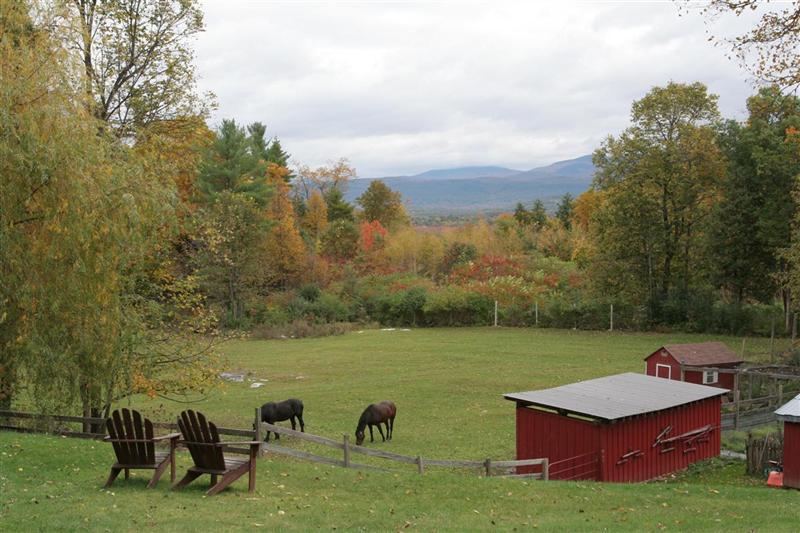
 Central New York’s Finger Lakes region, named for a handful of long, skinny lakes carved out by glaciers, has become famous for its wineries, and has a rich local foods culture that is beautifully displayed in places like the Ithaca Farmers Market.

Pompanuck Farm Institute, also in upstate New York and 3.5 hours from both New York City and Montreal, is a non-profit that hosts courses, concerts, and events related to the arts, gardening, and sustainability. The institute is located on 78 acres of fields, forests and streams, and offers personal retreats in private or shared guest houses, or primitive camping. Some buildings are powered with solar panels.

D Acres of New Hampshire Organic Farm and Educational Homestead offers primitive camping as well as private or shared hostel accommodations in a beautiful modern farm house in Central New Hampshire. The farm is located on 180 primarily-forested acres, and has 3 acres of fruit and vegetable gardens, as well as chickens, pigs, and oxen. The farm has a freestanding solar array that rotates to follow the sun, as well as solar hot water and a solar-powered irrigation system. (Disclaimer: I worked as the Garden Manager at D Acres in 2005)

Photo caption: Sherri Woolworth and her daughter, Jordan, watch the sheep eat after giving them some hay at Leaping Lamb Farm on Thursday morning. The Woolworths are from Tacoma and are staying at the farm stay to get away from a busy city life and give their children an opportunity to see first hand about the animals they are learning about in school. (Casey Campbell | Gazette-Times)
-------------------------------------------------------------
A blog called Experience Tuscany had a bit on agriturismo in Tuscany today. In Italy, agritourism doesn't have the broad definition that it does here. It simply refers to farm stays. And according to this post, Tuscany has 3500 of them! Holy moly! Agritourism in Italy is sure well developed, in part thanks to subsidies from the Italian government and the European Union. These governments see agritourism as desirable for a few reasons: maintaining rural traditions and livelihoods, keeping agricultural landscapes productive and viable, and dispersing tourism away from congested cities, to name a few. The agritourism grants particularly provide capital for farmers who want to invest in new infrastructure or restore old buildings into guesthouses. Though the grants have been subject to some abuses (i.e. people who use the money to restore a building, but never really open their doors to guests), the government seems to have gotten better at regulating this. In many cases, the rules are quite strict. State governments, for example, determine the percentage of food the must come straight from the farm, as well as the percentage of food that must come from the immediate area. These numbers vary from state to state, but the amount of local food that agriturismi must serve usually approaches 100 percent.
By the way, Italy is where I first fell in love with farm stays. I was studying in Rome for a semester, and decided to do a project on the country's agriturismi. Staying on Italian farms is a wonderful experience. They often serve dinner and breakfast both, around a long table that holds all of the farm guests. The food is the very best you'll have anywhere, and because the food comes straight from the farm and the surrounding area, your hosts often tell you about the nuances of the regional cuisine, along with its history. It's a lot of fun to interact with the other guests and the friendly farm owners too. It's a dolce vita.
My favorite agriturismo (out of three I visited with my family) was called Giandriale. Giandriale is high up in the Ligurian mountains, with cool, sweet air and old stone buildings. The farm produces organic (in Italy they call it biological) vegetables, herbs, and honey on its sloping fields, and there is plenty of hiking and biking in the mountains and forests around the farm. Regional specialties include delicious cakes prepared with corn or chestnut flour, and chestnut gnocchi.
 Feather Downs, a Europe-based upscale farm stay chain that sets up participating farms with fancy platform tents and other amenities in exchange for a large portion of farm stay revenue, is getting quite of bit of press lately. First, the New York Times article, "$300 a Night, but Haying's Free," about a Feather Downs farm stay in New York, which you can read here on the Backyard Farming blog. Then, a piece from the Conde Nast Traveler Daily Traveler blog about how lovely and restful the Feather Downs farm stay accommodations are, particularly in this stressful economy. Particularly worth mentioning is this quote: "There are a number of different farms to chose from in rural spots like the Catskills and Illinois, and the company plans to have 20 to choose from in the next year." Sounds like the chain is growing fast. It's great that farm stays are getting press, but too bad that the journalists don't mention that there are plenty of more affordable farm stay options.


 Posts
All Comments
Posts
All Comments


.jpg)


